





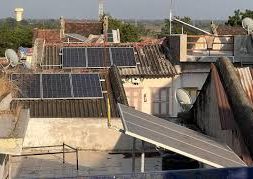


In Short : Solar-powered aquaculture is emerging as an innovative solution in rural China, combining fish farming with solar power generation. By installing solar panels above fish ponds, communities can produce clean electricity while maintaining aquaculture operations. This dual-use approach boosts farmers’ income, supports renewable energy development, and helps reduce carbon emissions while promoting sustainable rural economic growth.
In Detail : These days, Cheng Youhe, 55 years old, is grateful for his profession, managing a seafood farm in Nanjing, China. He earns more, is able to employ many of his fellow villagers, and contribute to reducing carbon emissions while doing so. But his situation was not always like today.
Before managing the seafood farm, Cheng was already in the seafood business, working as a broker to organise supply and meet the demands of markets across Beijing, Shanghai, and Tianjin. However, unstable supply from the farming side and difficulties in fulfilling last-minute orders often led to customer dissatisfaction and the loss of long-term business partnerships.
During a field visit to Nantong, a city in East China, he came into contact with a Chinese company focused on agriculture and renewable energy. This encounter marked a turning point for Cheng, who then explored scalable aquaculture practices powered by renewable energy.
“I was deeply moved by the idea of earning an income while reducing carbon emissions,” he says. Particularly in winter, when air pollution is severe and transportation delays increase mortality rates of live seafood, replacing coal with solar power does not only improve the logistics, but also help restore the blue sky.
Furthermore, the use of floating solar photovoltaics (PV)—solar panels which are mounted on a structure that floats on water—for fisheries can decrease land use conflicts. It does not come as a surprise that China—which led the global solar PV capacity expansion with around 63% share in 2024—sees an increase in solar energy for productive uses.
Having been convinced of renewables’ uses and benefits for aquaculture, Cheng started managing 146.7-hectares of land in Nanjing for the specific purpose of solar-powered aquaculture. The land was loaned to him at a lower market rate by the company he previously met.
The site has a solar PV-installed capacity of 50 megawatt-peak, generating 60 million kilowatt hours of electricity annually. Serving as a demonstration zone for the integration of solar energy with aquaculture, solar power research, and eco-tourism, the site focuses on the Chinese mitten crabs farming.
Having received scepticism at the beginning of the farm’s operation, Cheng now sees people line up to join the business. Indeed, integrating renewable energy with agricultural activities offers a wide range of interconnected benefits for livelihoods, food and energy security, nature and climate, with the potential to increase food production and farmers’ income.
The following are the positive impacts observed in the village and the villagers’ lives upon the farm’s operation:
- Environmental improvement: In summer, solar panels provide shade that reduces pond temperatures by 3–5°C, preventing aquatic plants from dying off due to heat.
- Productivity gains: Average yield increased, producing up to 175 tons of mitten crabs annually.
- Improved livelihoods: Increased production increased partner farmers’ income dramatically, with some people earning over USD 138,000 a year.
“Within three years, we created our first millionaire out of this business. Every year now, the farm produces dozens of affluent farming households,” Cheng said proudly. “Seeing these results, I strongly believe that solar-powered fishery is the future of rural agriculture. I realised this green model was not just an upgrade in farming technology—it represents an entirely new vision for rural development,” he added.


