










Every agency that visited said 500 KW was impossible. Lumencity said yes — then spent 90 days proving why that answer required a completely different kind of engineering.
Every project has a story. Some have a legend. This is ours.
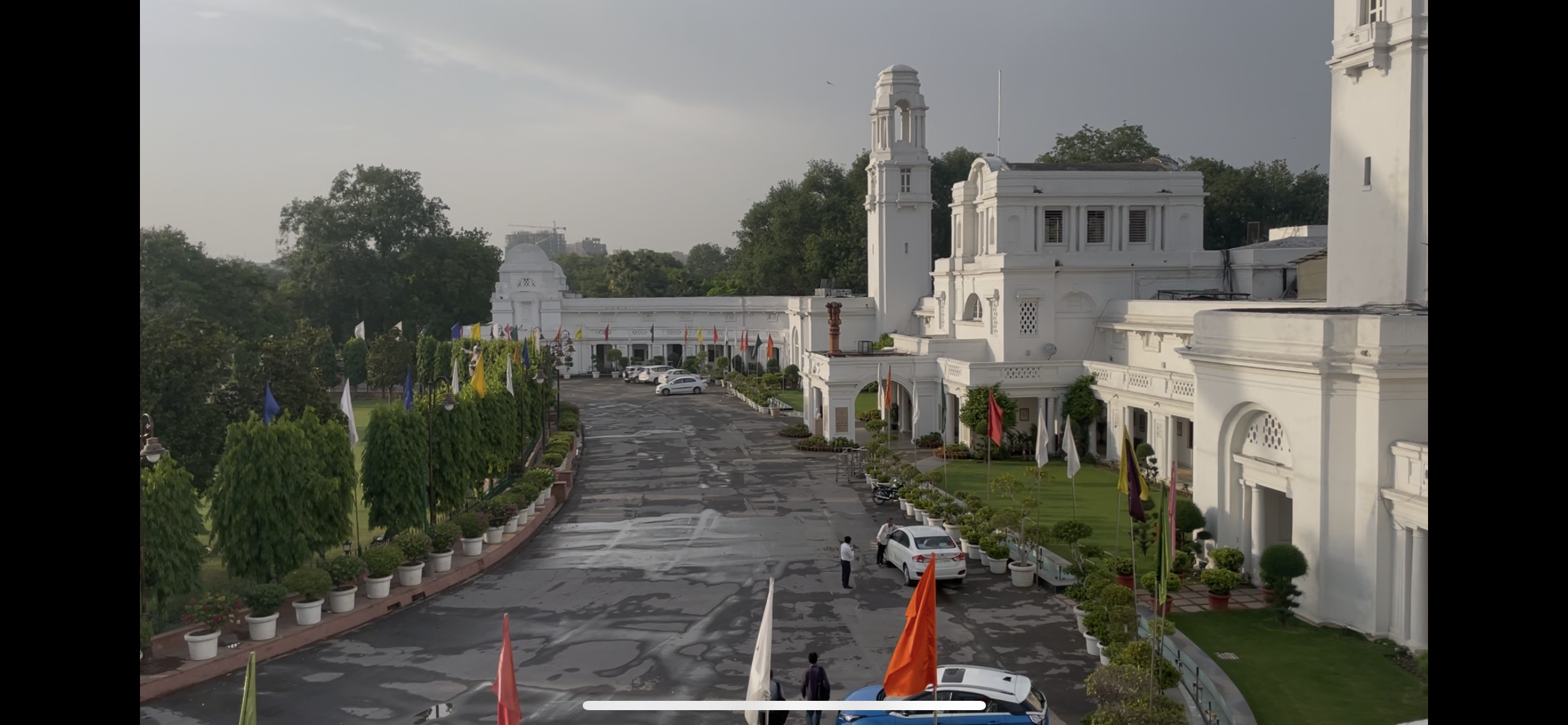
Our team at Lumencity visited the rooftop of the Delhi Vidhan Sabha — not as contractors who had won a bid, but as engineers answering a call from a government official who had spent months watching our solar education content on YouTube.
What we found on that roof would have sent most companies home. What happened in the 90 days that followed has, as far as we know, never been done before in India.
What We Found: A Broken System and an Impossible Brief
The Delhi Vidhan Sabha already had a solar rooftop system — 200kW, installed just five years prior. On paper, it should have been working. In practice, it was generating less than 10% of rated capacity.
The reasons were immediately apparent. Trees flanking both sides of the rooftop had grown above the building’s parapet, casting shade across large sections of the panel array. And then there was the other problem — one no solar specification document accounts for. Monkeys. The local primate population had been systematically dismantling the installation: broken panels, severed cables, connectors pulled loose.
These were manageable. The real problem was the target. The government engineers wanted 500kW. Every agency that had visited the site had delivered the same verdict: 300kW maximum. 350 at the absolute outside. Five hundred is not possible on this roof.
The Insight: Going Vertical
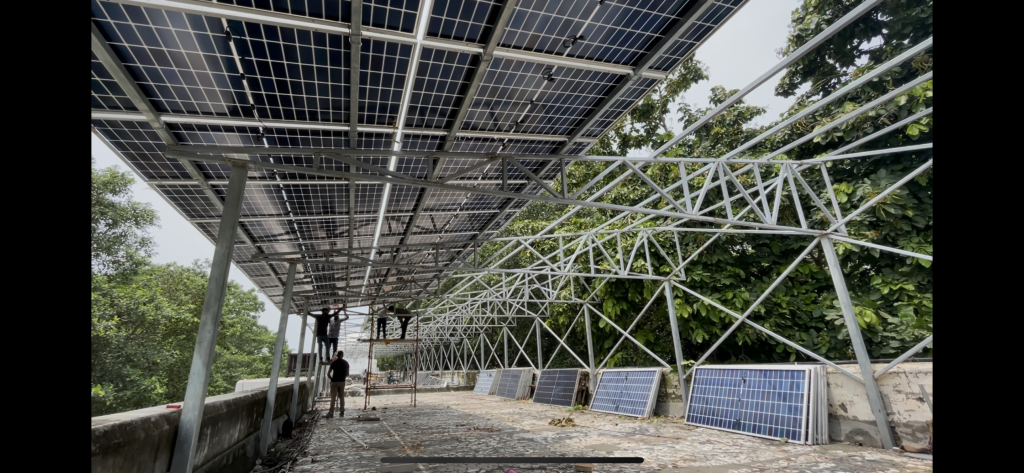
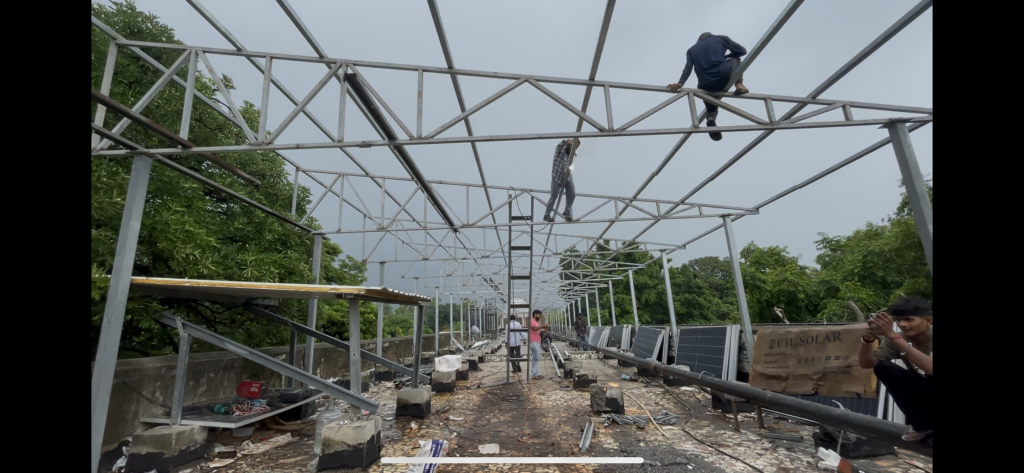
We proposed something that had not been attempted on a building of this vintage: a 14-foot high-rise mounting structure. By elevating the panel array by 14 feet, we would accomplish two things simultaneously — clear the tree canopy causing shade, and dramatically expand available installation area by enabling upper and lower panel rows across the same footprint.
The maths suddenly worked. 850 panels. 500kW. On the same roof everyone had written off at 300.
We also specified SolarEdge power optimisers on every panel. Trees, unlike buildings, keep growing. In a conventional string inverter system, one shaded panel degrades the output of the entire string. Optimisers decouple each panel, allowing independent operation. For a heritage site surrounded by mature trees, this was not a value-add. It was a system protection requirement.
The engineers agreed. The budget was set at Rs. 2.94 crore, with a 90-day completion deadline. We won the bid.
Day One: The Rules Changed
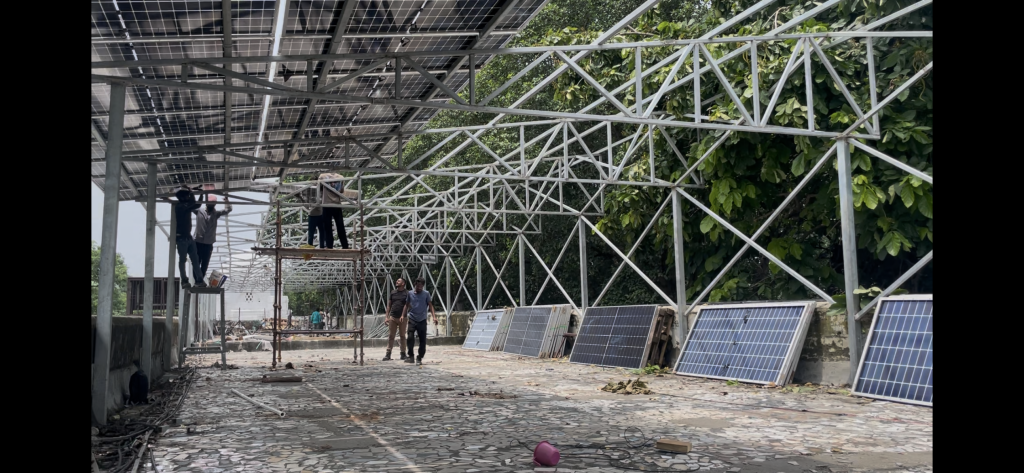
On 12th May 2025, the project was officially announced. It was also the day we began dismantling the old 200kW system. And the day we were told that drilling into the roof was not permitted.
The building was constructed in 1912. Given its heritage status, no chipping, drilling, or cutting into the lentil — the roof beam — would be allowed. A 14-foot structure must be certified to withstand 180 km/h wind loads under STAAD Pro analysis. That certification requires proper foundation anchoring. Without drilling, a structure of that height is, by conventional structural engineering logic, not buildable.
Our structural engineer went cold. We pushed back hard — this constraint had never been disclosed during the tender process. But we had taken on the work. We had to find another way.
The Maze, the Monsoon, and the Dead Ends
The Vidhan Sabha rooftop is not a compact square. It is a gallery — a narrow corridor stretching 1.5 kilometres from end to end. A worker moving from one panel section to the other had to walk 1.5km in direct sun, descend via the single central staircase (wide enough for exactly one person), and climb back up the other side. Getting a bottle of water from the far end took 45 minutes.
Then the monsoon arrived, halting outdoor work entirely. We consulted some of India’s most respected solar structure engineers. The consensus: without drilling, a 14-foot certified structure is not achievable. The only alternative suggested was extreme ballast — making foundations so heavy that wind forces could not topple them.
We ran the numbers. The building’s lintels — over a century old — could not carry that load. Ferro scanning and rebound hammer testing confirmed it: load-bearing capacity was insufficient. Back to zero.
The Evening That Saved Everything
It was July. It had rained. Five engineers sat on the Vidhan Sabha rooftop watching the sun descend over the building’s magnificent gardens. One of our engineers had been staring at the large water storage tanks on the roof for several minutes without speaking.
“Did you notice the tanks are not sitting on the roof directly? There is an iron beam going through the wall. The weight of the tanks goes to the walls — not the slab.”
Five engineers. Hundreds of site visits between us. None of us had noticed.
The walls of a 1912 masonry structure carry significantly more load capacity than the roof slab. And drilling into walls — not the lentil — had never been explicitly prohibited. We redesigned the foundation system entirely: a threaded rod passed horizontally through the wall, with the base plate fixed laterally against it. Structural loads transfer into the masonry walls, not the roof surface.
We ran it through STAAD Pro. It cleared 180 km/h.
Execution: 100 People, One Machine
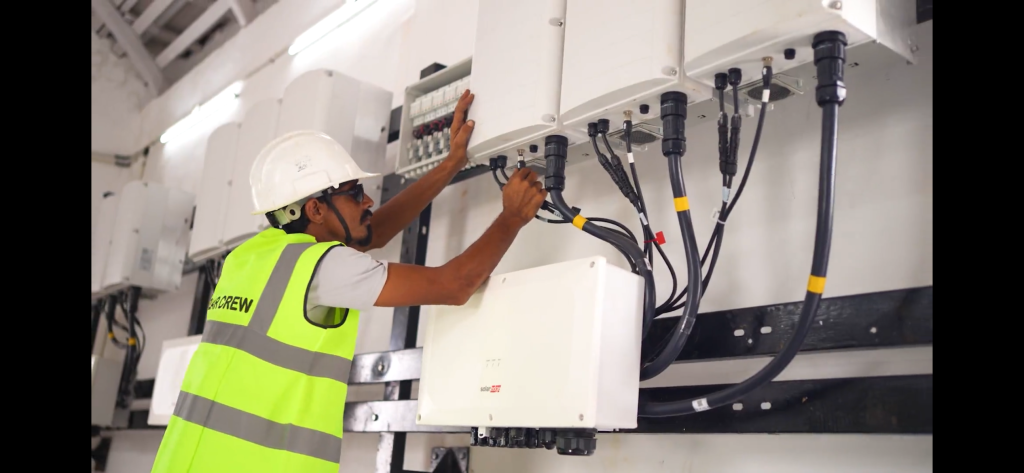
Once the structural solution was confirmed, execution moved at pace. A team of 100+ people — structural fitters, electricians, quality supervisors, logistics coordinators — worked in coordinated shifts across both wings of the 1.5km gallery roof.
The monkey problem was solved with cable trays installed behind the panel arrays, housing the SolarEdge optimisers and all primary wiring within a protected enclosure — removing exposed cabling from wildlife reach and ensuring long-term system reliability.
| 5 April 2025 | First site visit. Old 200kW system found generating less than 10% of rated capacity. |
| 12 May 2025 | Project announced. Dismantling begins. No-drilling constraint revealed on Day 1. |
| July 2025 | Wall-anchored foundation concept discovered on-site. STAAD Pro simulation clears 180 km/h. |
| 3 August 2025 | Inaugurated by Union Minister Arjun Ram Meghwal, Speaker Vijender Gupta, CM Rekha Gupta. |
| 9 May 2026 | 5,58,000+ units generated. Rs. 44L+ saved. Vidhan Sabha achieves net-zero electricity status. |
What This Project Proved
The agencies who said 500kW was impossible were not wrong within their own framework. They were wrong about the framework.
Solar in India is still too often treated as a commodity. The Vidhan Sabha project demonstrates what becomes possible when genuine engineering rigour meets a genuinely difficult problem.
We are a company that began by educating people about solar energy on YouTube, because we believed that an informed customer gets a better system. The Vidhan Sabha engineers found us through that content. Together, we found a solution that no one else had been willing to look for. That is what solar in India can look like.
ABOUT LUMENCITY
Lumencity is a New Delhi-based solar and LED lighting company with over 1,00,000 YouTube subscribers and 57,000+ Instagram followers, grown entirely without paid advertising through educational content on solar and renewable energy. The company supplies solar street lights, rooftop solar systems, solar flood lights, and LED lighting to residential, commercial, housing society, and institutional clients across India.
